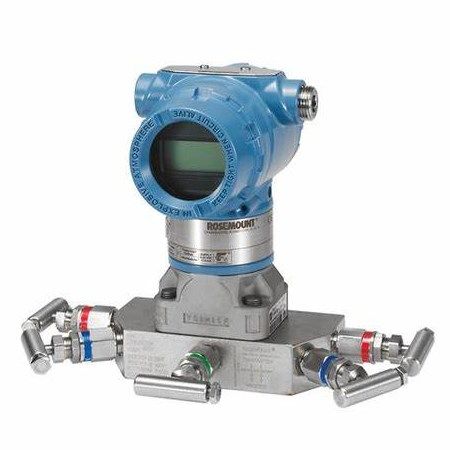
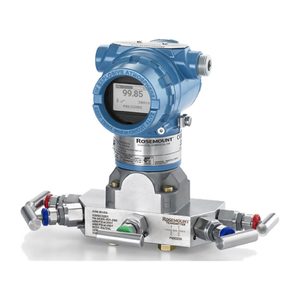
Hygienic Offering: Rosemount 3051 transmitters meet the requirements of hygienic applications. They are constructed in compliance with industry standards, as well as regulations. These transmitters are provided in stainless steel and aluminum housing. The transmitters are rated up to IP689K, and they can easily withstand sterilize-in-place as well as clean-in-place processes. They can be returned to the calibrated set point easily.
Why Rosemount 3051 Pressure Transmitters ? Rosemount 3051CD2A22A1AB4 3051C Coplanar Pressure Transmitters
In addition to the above-mentioned features, all Rosemount 3051 series pressure transmitters assure the following:
• Reference accuracy of up to 0.04%
• Five-year stability on first installations
• Unmatched performance in dynamic applications
• Advanced Plant Web functionality to improve the productivity of plants
• Improved performance when integrated with DP level, DP flowmeters, and manifolds
Types of 3051 Transmitters Rosemount 3051CD2A22A1AB4 3051C Coplanar Pressure Transmitters
At The Transmitter Shop, we provide the following Rosemount 3051 pressure transmitter models:
• 3051S Series SMART® Pressure Transmitters
• 3051C Pressure Transmitters
• 3051T Pressure Transmitters
• 3051L Level Transmitters
Difference Between 3051C Vs 3051S Rosemount 3051CD2A22A1AB4 3051C Coplanar Pressure Transmitters
Rosemount 3051S series SMART® pressure transmitters and Emerson 3051C coplanar pressure transmitters are widely preferred in process industries, owing to various beneficial advantages that they offer. The following points will help you understand it better:
• 3051C pressure transmitters are equipped with a flexible coplanar platform and 3051S pressure transmitters with hermetic SST SuperModuleTM platform. Both these features, along with advanced diagnostics enable users to access device and process information effectively.
• 3051S assures 0.025% accuracy and range down of 200:1. So, this pressure transmitter is a perfect choice if accuracy and turndown ratio is your main concern.
• 3051C is suited for applications, where turndown ratio and accuracy may not be a big concern. It is also considered an ideal choice if a process owners want to save money while remaining productive and safe.
How to Configure 3051 Transmitter Rosemount 3051CD2A22A1AB4 3051C Coplanar Pressure Transmitters
Configuration of Emerson Rosemount 3051 transmitter needs to be performed according to the guidelines provided by Rosemount. The following steps will lead to accurate commissioning of the transmitter.
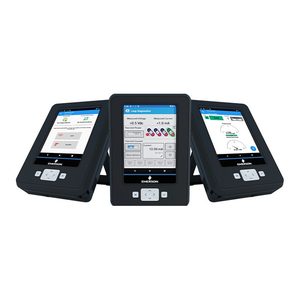
• Commission the transmitter on the bench using an AMS Device Manager or a HART® communicator.
• Set the process application loop to manual. The HART® communicator or the AMS Device Manager will prompt for this action.
• Connect the bench equipment and wiring loops as per the below wiring diagram.
• Review the default configuration data using the AMS Device or the HART® Communicator.
• Review the parameters of digital output before performing any on-line operations with the transmitter. This will help you ensure that the transmitter is performing properly, and is configured to right process variables.
• Set the process variable units, output (transfer function), and range values.
Rosemount 3051CD2A22A1AB4 3051C Coplanar Pressure Transmitters
• HART® stands for Highway Addressable Remote Transducer, which is a popular digital communications protocol developed by Rosemount. This protocol facilitates easy interfacing of HART-enabled master devices with HART-enabled field devices. It is one of the most widely used digital communications protocols used for process control, owing to several advantages that it offers. This protocol can communicate over 4-20 mA analog wiring, and is also compatible with old wiring systems, which makes it an excellent choice for digital communications. The following advantages of the protocol have contributed to its easy acceptability across the world.
• HART® helps reduce set-up time by enabling the safe transfer of calibration information and configuration settings.
• It is designed to capture performance data and manufacturing errors remotely, thereby eliminating the need for regular field checks, and helps process control managers to reduce maintenance costs. The data can be easily accessed on any HART-enabled device working on a 4-20 mA signal.
• The protocol can be interfaced with smart multivariable devices to receive accurate reports. This ability is owing to Device Description (DD), which is a data file describing the functions and features of the instrument. The HART® Communication Foundation possesses a library of device descriptions for manufacturers. They also regularly update the descriptions that any member of the foundation can easily subscribe.
• The protocol assures regulatory compliance with automated record keeping.
How to Troubleshoot Emerson Rosemount 3051 Pressure Transmitter Rosemount 3051CD2A22A1AB4 3051C Coplanar Pressure Transmitters
The Rosemount 3051 pressure transmitter provides 4-20mA analog output, with a HART® signal on 4-20 mA output. Here, the HART® signal is superimposed on the output. The following are a few tips that will help troubleshoot for 4-20mA output and make necessary arrangements.
• The milliamp reading of transmitter is zero: If this happens, you need to ensure the power is applied to the signal terminals, and the terminal voltage is set to 10.5 to 42.4 Vdc. Also, check the wires for reverse polarity, and check the open diode.
• The milliamp reading is extremely high or low: If you notice this during servicing, you need to verify applied pressure, as well as 4-20 mA range points. Also, ensure that the output is not in the alarming condition, and the power wires are connected to the right signal terminals, and not the test terminal.
• Transmitter is not communicating with field communicator: This may be due to various reasons. You need to check if the terminal voltage is set at 10.5 to 42.4 Vdc, the loop resistance is 250Ω minimum, the power wires are connected to the right terminals, and output is between 4 and 20mA or at saturation.
• Transmitter is not responding to applied pressure: If this happens, you need to check the manifold or impulse piping for leakage. Additionally, you need to ensure that the applied pressure is only between 4 and 20mA points, the output is not in alarming condition, and the transmitter is not in a loop test mode.
• The pressure variable reading of digital pressure is high or low: When this is noticed, you need to check the accuracy of the equipment used for testing. Also, check for the blockage in impulse piping or low fill in wet lag. Ensure that the transm- itter is calibrated properly and verify pressure calculations, too.
• The pressure variable reading of digital pressure is erratic: To correct this, you need to check for faulty equipment in pres sure line, verify the transmitter is not turning on/off with the equipment, and damping is properly set.
• Milliamp reading is erratic: If you notice erratic Milliamp reading, you need to verify a few things such as checking for external electrical interference, grounding of the transmitter, if the shield for the twisted pair is grounded at the end, and power source to transmitter has adequate current and voltage.
How does a Rosemount 3051 transmitter Work? Rosemount 3051CD2A22A1AB4 3051C Coplanar Pressure Transmitters
All Rosemount 3051 transmitter products feature calibration and reset options. These reset options enable the re-setting the measuring span to suit application requirements. The sensors of these transmitters work by converting the pressure readings into an analog electrical signal.
Integral Manifolds Solution for Rosemount Transmitter 3051 Rosemount 3051CD2A22A1AB4 3051C Coplanar Pressure Transmitters
We provide the following types of integral manifolds for Rosemount 3051 pressure transmitter models.
• Rosemount 304 Conventional Manifold
• Rosemount 305 Integral Manifold
• Rosemount 306 In-Line Manifold